
Vipers
Bugloss
Vipers
Bugloss honey is produced predominantly in the Marlborough and Otago provinces
in New Zealand's South island. Other areas do produce Vipers Bugloss from time
to time, but are not the reliable producers of quality product that Marlborough
and Otago provinces are.
The honey has a delicate flavour with a floral bouquet and being high in fructose
is excellent as a drink sweetener, especially coffee where it imparts
another flavour dimension. Vipers Bugloss is a close relative of Salvation Jane
(Echium plantagineum), another well known honey plant from Australia.
The Vipers Bugloss plant (Echium vulgare) is also variously known
as "Borage" and "Blue Borage" and this at times leads to
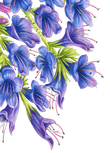
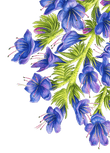
considerable confusion when the culinary herb Blue Borage (Borago officinalis
- see photo on
left), is mistaken as the source of this honey. Some beekeepers and honey marketers
also refer to Vipers Bugloss honey as "Borage" and "Blue Borage"
honey with several products being marketed under these names in the New Zealand
domestic market. At present none of these products are Borago officinalis
honey.
There have been seasons when large quantities of Blue Borage (B. officinalis)
are cultivated as a seed crop in Canterbury province, primarily for the extraction
of Gama Linoleic Acid (GLA), and a surplus honey crop from this source can arise.
It is not known if GLA is found in the honey from this source.
Vipers Bugloss on the other hand is not a cultivated plant but rather grows
wild in arid areas with poor soils. When young, the plants are
highly palatable to sheep and many high country farmers rotate their stock in
time with the growth of Vipers Bugloss. Sometimes this is to the advantage of
the beekeeper, at others not. Vipers Bugloss is a biannual and grows with a
long root system making it drought resistant. It yields nectar at lower temperatures
than clover and the resultant honey is often very dry with a chewy or tacky
texture.
Colour
The honey averages 23.9mm on the Pfund
scale with a
standard deviation (SD) of 10mm (640 measurements). It also darkens at
a faster rate (double) than most other New Zealand honey and the colour has
a brown tint to it. The Pfund grader glass wedge is a "generic"
honey hue. Vipers Bugloss honey is more brown that this generic colour.
Sugar
Profile
Vipers Bugloss is a slow
crystallizing honey with a low (Glucose-Water)/Fructose
ratio.
Averages for:
Glucose 30.2% (SD 2.2)
Fructose 36.4% (SD 2.0)
Sucrose 2.9% (SD 2.2)
It should be noted that the above values for sucrose indicate that there are
occasions where the maximum level of 5% in some countries will be exceeded for
this honey type.
It is a more reliable crop than Nodding Thistle (our
other slow crystallizing, light coloured honey) and so is sought after as a
source of comb honey for the production of chunk
honey. There are few honey types in the World that can reliably be used for
chunk honey and Vipers Bugloss is one of them.
Crop Timing
Vipers Bugloss flowers from December to March and peaks dependent on available
moisture. Rain during the flowering period can extend the flowering or start
a heavier flowering if dry conditions have prevailed prior to rain.
home
return to top of page
© 1999
Airborne Honey Ltd